
Are you confused about the new regulations and what they actually mean? Here at F1 Chat we are keen to help everyone understand the biggest changes in the history of F1.
Big rule changes comes every 4 to 6 years, these resets help by
- Improving racing
- Attracting new manufacturers
- Increase safety
- Support sustainability goals
All in all, for a fan, a regulation change is generally a good thing and helps keep the sport fresh. It prevents too much dominance by one team.
🚗 Smaller, Lighter, More Agile Cars
The 2026 cars are smaller and lighter than cars of the past, that had almost become bloated in size compared to cars of the past. They have a shorter wheelbase, are slightly narrower and weigh around 30kg less. The picture below shows these differences well.
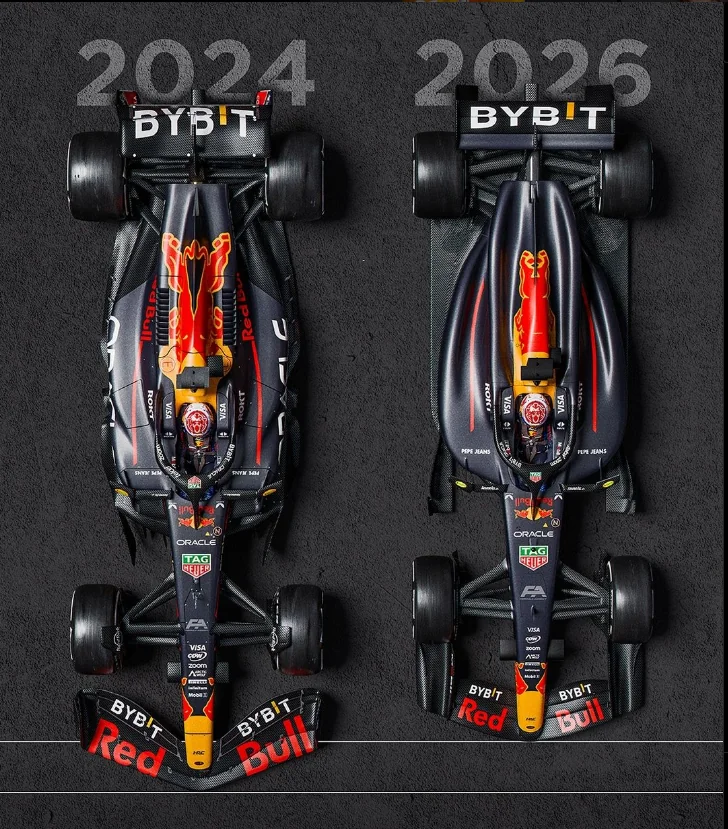
This will make racing much more exciting again as a smaller, lighter car are easier to race wheel-to-wheel, more agile round bends and better able to follow another car closer. This should mean more overtaking and better racing battles. However, this will be affected by the other major change which is the changes in the Power Unit regulations for these cars.
⚡ A Major Engine Overhaul
The Power Unit in an F1 car has been based on 1.6-litre turbo B6 for a while now, but this year the way that the power is produced in these cars has changed hugely. This has brought in some exciting developments from manufacturers – loops holes being explored in something that is almost akin to the Brawn era of regulation change.
In 2026:
- 50% of the power will come from the electric system
- 50% will come from the combustion engine
The complex MGU-H system (which recovered heat energy from the turbo) is being removed to simplify engines and reduce costs. Instead, the electric motor (MGU-K) becomes much more powerful, meaning cars will recover and deploy far more energy under braking.
In addition to this and something which is potentially good news for us ICE loving car owners is that the cars will run on 100% sustainable fuel. This fuel is carbon neutral, being made from non-food sources or captured carbon. F1 is often the innovator for new technology that ends up in our normal day to day cars and this is very exciting.
🌀 No More Traditional DRS
Active Aerodynamics is a big visibible change for F1 cars in 2026, the new cars have wings that can adjust between high downforce mode for cornering and low drag mode for straights.
This will be deployed manually by the drivers giving then extra electric power when attacking or defending. A very much driver controlled process rather than the automatic DRS of the past.
🛡️ Improved Safety
Safety is always at the forefront of planning by the Fédération Internationale de l’Automobile (FIA).
In 2026:
- Stronger crash structures
- Improved front and side impact protection
- Better roll-over protection
- New warning lights to show when high-voltage systems are active
Since the bad days of the 70s and 80s, the FIA have pushed forward to constantly look at ways to make F1 cars as soon as safe as possible. While we all like to see close battling, it is reassuring that if it all does goes wrong that the drivers have as much chance as possible at getting out of their cars alive each race.
🏭 New Manufacturers Joining
One of the reasons why Audi has waited to 2026 to join F1 is due to the change in regulations. The German car company have a firm commitment to the environmental effects of cars and so were not prepared to join F1 until the changes to the power units was made.
Cadillac make up the eleventh team for the first time since 2016, prior to that up to 12 teams ran in the 2010 to 2012 seasons. The American teams addition means that we now have two American teams, showing the rise of F1 in the USA. Which is an achievement, given their love of Nascar.
🌍 Sustainability Goals
Formula 1 aims to be net-zero carbon by 2030. The 2026 rules are a huge part of that plan:
- Sustainable fuel
- More electric power
- Improved energy efficiency
- Reduced fuel flow
In Simple Terms
The resetting of rules in 2026 are designed to keep Formula 1 fast and exciting – while making it cleaner, smarter, and more future-focused. Whether that actually is how it ends up will play out over the season.
It’s been interesting so far watching and looking over the analysis from the Barcelona Shakedown and first test in Bahrain. Some questions and issues have been raised but we won’t fully know just how each team has successfully tackled the problems that a regulation change brings until we see the first race in Australia in a few weeks.
Leave a Reply